Shaoliang Yang

Ph.D. Candidate · Mechanical Engineering · Santa Clara University

Shaoliang Yang

I build machine learning for mechanical design that stays accountable to mechanics.

I am a Ph.D. candidate advised by Prof. Jun Wang, expecting to complete the degree in June 2027. My work develops generative models that produce engineering geometry an engineer can actually edit, solvers fast enough to explore a design space rather than a single design, benchmarks that say when a learned method can be trusted, and language-model agents that steer those solvers under deterministic checks. The rule throughout: the model proposes, the mechanics decides.

Before Santa Clara I trained in automation and control (B.E., Kunming University of Science and Technology; M.Eng., Yunnan University), where I worked on deep generative models for low-light imaging.

Research

Machine learning now proposes mechanical geometry faster than engineers can evaluate it, so the hard problem has moved from generating designs to deciding which ones deserve to be believed. My research sits at that boundary, in four connected threads.

01

Inverse design of architected materials

Given target effective properties, which cellular geometries achieve them? The answer is rarely unique, and that is useful: diversity lets a manufacturing constraint eliminate one candidate without collapsing the design space. Style-IH-GAN generates diverse triply periodic minimal surface unit cells for prescribed properties and emits spatially graded fields in one pass, with fidelity checked by numerical homogenization over 750 samples. CH-WGAN extends this to uncertainty-aware generation of three-dimensional aperiodic structures through signed distance fields.

Engineering with Computers 42:148 (2026, open access) · Journal of Mechanical Design 148(12):121701 (2026)
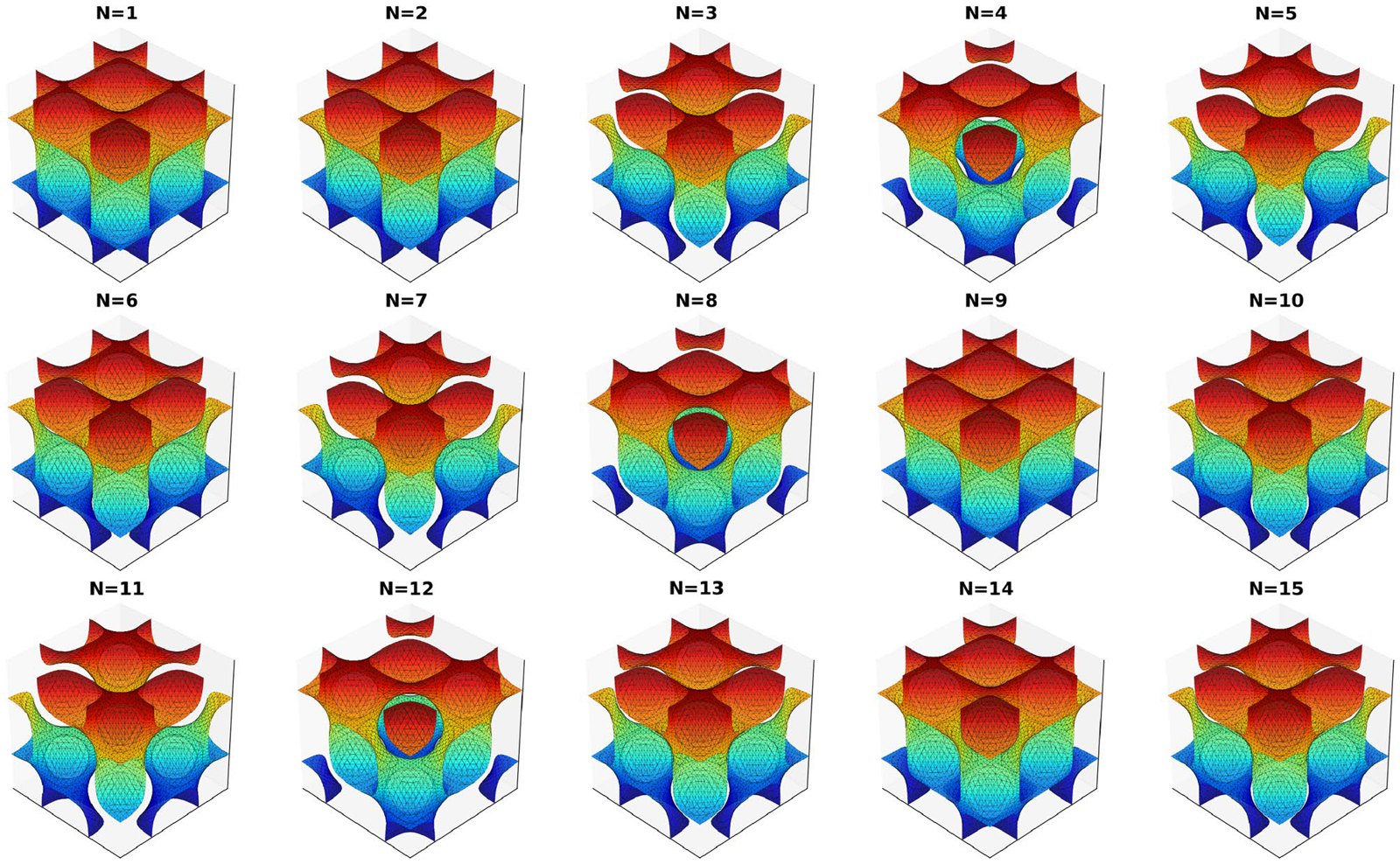
Fifteen different generated unit cells, all produced for the same target properties
One target, fifteen answers: unit cells generated by Style-IH-GAN for the same requested properties.

02

Generative models inside CAD representations

A generated raster cannot be revised; a spline can. NURBS-OT and parametric autoencoders generate curves and cellular surfaces directly as B-splines and NURBS with interpretable controls, so an engineer can move a control point and see a sensible change, and the geometry flows straight into isogeometric analysis and CAM.

Journal of Mechanical Design 147(3):031703 (2025) · Computer-Aided Design 189:103936 (2025) and 196:104064 (2026) · ASME IDETC/CIE 2024

Illustration: a curve stored as a spline with a control polygon. Moving one control point produces a local, predictable change. move one control point → a local, predictable change
Illustration (not a result): geometry kept as a spline with an editable control polygon, the representation NURBS-OT generates in.

03

Scalable, verifiable topology optimization

Matrix-free 3D SIMP with fused Gather-GEMM-Scatter kernels and a matrix-free Galerkin multigrid solver put large three-dimensional topology optimization on a single GPU, released as open source. Speed is only useful if the answer can be trusted, so the same line of work adds a guarded density-floor policy that returns a linear solve only after its true residual passes an acceptance test. NeuralTO-Bench compares classical and neural mesh-free methods on equal terms.

arXiv:2604.18020 · arXiv:2604.26441 · arXiv:2607.26382 · ASME IDETC/CIE 2026 · solver code under BSD 3-Clause

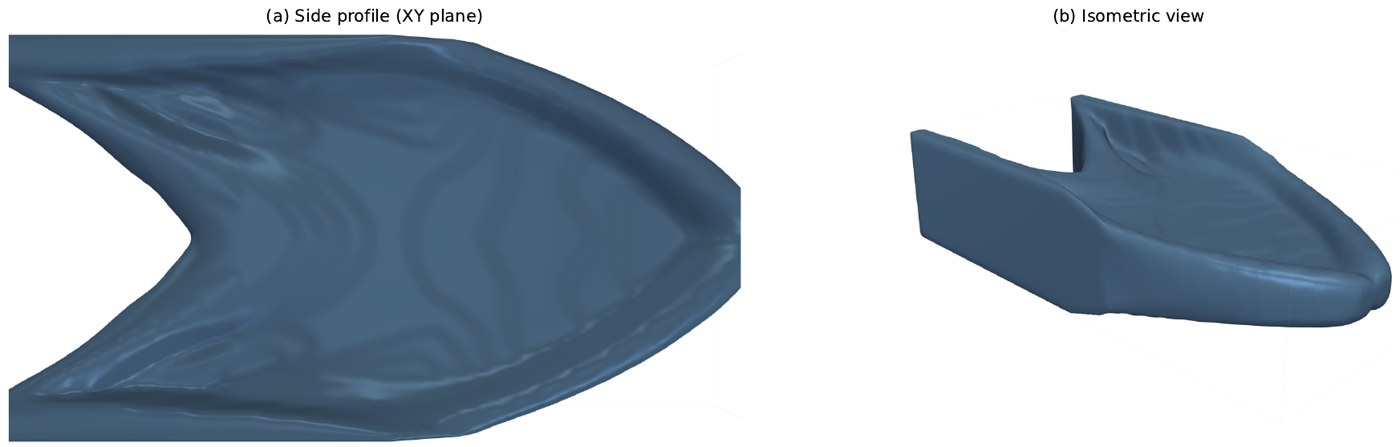
Optimized cantilever topology at one million elements, side profile and isometric view
Cantilever topology at 200 × 100 × 50 = 1,000,000 elements, optimized with the fused matrix-free kernel on one GPU. Smoothed isosurface; left, side profile; right, isometric view.

04

Language-model agents around engineering solvers

Language models can now read a solver's state and act on it. I use them as a control layer: the model sets continuation parameters from the live solver state, configures a topology-optimization problem from a plain-English description, or proposes spatial edits after each solve, and deterministic checks decide what is accepted.

Across three studies the model steers the solver competitively, but a well-designed deterministic baseline stays close or ahead each time. That is why acceptance rests with explicit checks, not with the model. The same split carries over to materials search: a language model parses the request, and a deterministic search over a homogenised lattice catalogue either returns a cell a second solver can rebuild or refuses, naming the minimal set of conflicting constraints.

Advances in Engineering Software 223:104304 (2026) · AutoSiMP, arXiv:2603.27000 · IterSIMP-σ, arXiv:2605.19110 · arXiv:2609.14741 · code under BSD 3-Clause and MIT

Closed loop: solver state goes to a language-model controller, which proposes parameters; a SIMP step runs; admissibility checks certify the result before it is accepted. Solver statecompliance · grayness · budget Language modelproposes p, β, filter, move limit SIMP stepFEM solve · sensitivities · update Admissibility checkssolver certifies, not the model The model proposes; the solver certifies.
Language model as a control layer around a SIMP solver. In the pipelines built on it, acceptance rests with the solver and explicit checks.

One question, what does a learned transformation destroy?, also drives related work on defect-evidence benchmarks for semiconductor inspection, risk certificates for industrial image restoration, and calibrated remaining-useful-life prediction under operating-regime shift.

Publications

Each entry links the published paper, the arXiv version and the code where they exist. Open Details for a summary, key results and BibTeX. Full list on Google Scholar.

Journal articles 10

Pipeline
Result

Figures from this article. © The Author(s) 2026, CC BY 4.0

Style-IH-GAN: Diverse Inverse Homogenization and Continuous Graded Synthesis of Cellular Metamaterials

S. Yang, J. Wang

Engineering with Computers 42:148, 2026 open access

Architecture
Result

Figures from this article. © 2026 ASME

CH-WGAN: Uncertainty-Aware Generative Design of Three-Dimensional Aperiodic Architected Cellular Materials via Signed Distance Fields

S. Yang, J. Wang

Journal of Mechanical Design 148(12):121701, 2026

Pipeline
Result

Figures from this article. © 2026 Elsevier Ltd.

Large Language Models as Optimization Controllers: Adaptive Continuation for SIMP Topology Optimization

S. Yang, J. Wang, Y. Wang

Advances in Engineering Software 223:104304, 2026

Architecture
Result

Figures from this article. © 2026 The Authors, published by Elsevier Ltd., CC BY-NC 4.0

Interpretable neural basis approximation for periodic cellular surfaces through analytic primitive mixtures

S. Yang, J. Wang

Computer-Aided Design 196:104064, 2026 open access

Architecture
Result

Figures from this article. © 2025 The Authors, published by Elsevier Ltd., CC BY-NC 4.0

Triple-parametric autoencoder for 2D reparameterization via Bézier, B-spline, and NURBS representations

S. Yang, J. Wang

Computer-Aided Design 189:103936, 2025 open access

Architecture
Result

Figures from this article. © 2024 ASME

NURBS-OT: An Advanced Model for Generative Curve Modeling

S. Yang, J. Wang, K. Wang

Journal of Mechanical Design 147(3):031703, 2025

Architecture
Result

Figures from this article. © The Author(s), under exclusive licence to Springer-Verlag GmbH Germany, part of Springer Nature 2023

Efficient low-light image enhancement with model parameters scaled down to 0.02M

S. Yang, D. Zhou

International Journal of Machine Learning and Cybernetics 15(4):1575–1589, 2024

Architecture
Result

Figures from this article. © 2023 IEEE

LightingNet: An Integrated Learning Method for Low-Light Image Enhancement

S. Yang, D. Zhou, J. Cao, Y. Guo

IEEE Transactions on Computational Imaging 9:29–42, 2023

Architecture
Result

Figures from this article. © The Author(s), under exclusive licence to Springer Science+Business Media, LLC, part of Springer Nature 2023

Single Image Low-Light Enhancement via a Dual-Path Generative Adversarial Network

S. Yang, D. Zhou

Circuits, Systems, and Signal Processing 42(7):4221–4237, 2023

Architecture
Result

Figures from this article. © 2022 IEEE

Rethinking Low-Light Enhancement via Transformer-GAN

S. Yang, D. Zhou, J. Cao, Y. Guo

IEEE Signal Processing Letters 29:1082–1086, 2022

Conference papers 4

Architecture
Result

Figures from this article. © 2026 ASME

NeuralTO-Bench: A Reproducibility Framework and Benchmark Foundation for Classical and Neural Mesh-Free Topology Optimization

S. Yang, J. Wang, Y. Wang

ASME IDETC/CIE IDETC2026-194238, 2026 accepted

Pipeline
Sample

Figures from this article. © 2026 ASME

Semantic Inverse Design of Cellular Structures in Implicit Field Space

Y. Wang, Z. Yashengjiang, B. Yu, S. Yang, J. Wang

ASME IDETC/CIE IDETC2026-194262, 2026 accepted

Architecture
Result

Figures from this article. © 2026 ASME

Inverse Inference of Aperiodic Structures: Decoding Signed Distance Fields into Learnable Parameters for 3D Reconstruction

S. Yang, J. Wang

ASME IDETC/CIE DETC2025-168575, 2025

Pipeline
Result

Figures from this article. © 2024 ASME

Enhancing Isogeometric Analysis with NURBS-Based Synthesis

S. Yang, K. Wang, J. Wang

ASME IDETC/CIE DETC2024-142195, 2024

Preprints 9

Method
Result

When a Positive SIMP Density Floor Is Not Enough: Solver Admissibility and Guarded Floor Selection in Matrix-Free 3D Topology Optimization

S. Yang, J. Wang, Y. Wang

arXiv:2607.26382, 2026 under review

Method
Result

Matrix-Free 3D SIMP Topology Optimization with Fused Gather-GEMM-Scatter Kernels

S. Yang, J. Wang, Y. Wang

arXiv:2604.18020, 2026 under revision

Method
Result

A Matrix-Free Galerkin Multigrid Solver and Failure-Mode Screen for Single-GPU 3D SIMP Linear Systems

S. Yang, J. Wang, Y. Wang

arXiv:2604.26441, 2026

Pipeline
Result

AutoSiMP: Autonomous Topology Optimization from Natural Language via LLM-Driven Problem Configuration and Adaptive Solver Control

S. Yang, J. Wang, Y. Wang

arXiv:2603.27000, 2026 under review

Pipeline
Result

IterSIMP-σ: Evaluating LLM-Assisted Spatial Interventions in Stress-Aware Topology Optimization

S. Yang, J. Wang, Y. Wang

arXiv:2605.19110, 2026 under revision

Pipeline
Sample

A property-registry contract for retrieve-or-refuse thermal-mechanical lattice search

S. Yang, H. Chu, Z. Yashengjiang, J. Wang

arXiv:2609.14741, 2026

Pipeline
Sample

Does Super-Resolution Preserve Defect Evidence? A Low-False-Call Benchmark for Semiconductor Inspection

S. Yang, J. Wang

arXiv:2607.17401, 2026 under review

Method
Sample

SafeRestore: Detector-Relative Risk Certificates for Selective Industrial Image Restoration

S. Yang, J. Wang

arXiv:2609.03475, 2026 under review

Architecture
Data

Empirical Calibration and Conditional-Reliability Diagnostics for Bearing RUL Prediction under Operating-Regime Shift

S. Yang, J. Wang, Y. Wang

arXiv:2607.08273, 2026 under review

Teaching

A student leaving my course should be able to take an engineering question, choose a computational approach, implement it, and then explain why the answer deserves to be believed. Software will produce a stress contour or an optimized topology; it will not say whether the result is right. So I teach verification as a primary skill: predict before you compute, check against known solutions, and treat disagreement between intuition and simulation as the lesson.

Experience

  • Grader, MECH 45 Applied Programming for Mechanical Engineers (two sections), Santa Clara University, Spring 2025
  • Guest lecture, Computational Geometry for CAD/CAM, Santa Clara University

Courses I am prepared to teach

  • Engineering programming
  • Engineering design
  • CAD & computational geometry
  • Introductory FEA
  • Graduate FEM
  • Engineering mathematics

Graduate electives I would develop

  • Topology Optimization and Generative Design
  • Scientific Machine Learning for Mechanical Engineering
  • Isogeometric Analysis and Computational Geometry

Service

  • Journal reviewer, Structural and Multidisciplinary Optimization, 2026

News